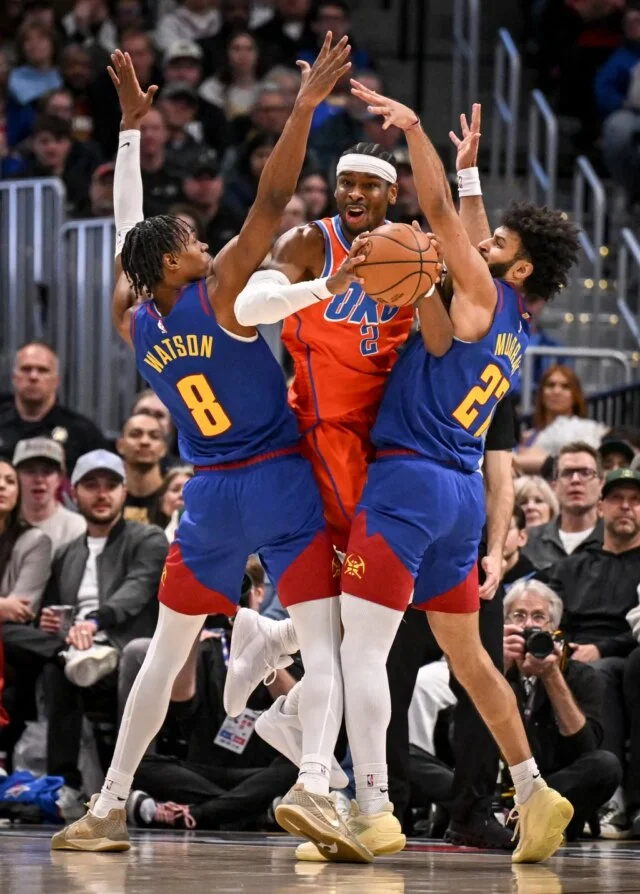
The Nuggets have once again broken historical precedent and are vying for the championship.
They’ve become an exception to the rules. In 2023, they made the playoffs, allowing 113.5 points per 100 possessions—ranking 15th in the NBA for defensive efficiency. That’s the lowest defensive ranking of any championship team in the last 24 years. Since the beginning of this century, only three championship teams have finished outside the top ten in the regular season, while 16 have finished in the top five. Since 2000, half of all championship teams have had a top-three defense.
Three years ago, a slight adjustment in the middle might have been enough. But in the Western Conference, led by the Oklahoma City Thunder, the bottom 10 teams are truly shaping Denver’s fate.
The Nuggets returned this week after the All-Star break with a 24th-ranked basketball defense. Their 116.9 rating is the worst among the top ten teams in the league.
Therefore, Denver’s initial focus was not mysterious: players and coaches reunited for a three-game road trip in the West. As usual, the main focus was on the injury report. With Aaron Gordon and Payton Watson sidelined due to hamstring strains, the path for meaningful defensive progress narrowed.
“We discussed this today. Before all the injuries cleared up, we were fourth in the league defensively and our offense was excellent,” head coach David Adelman said Wednesday. “We know what’s going on out there. We can get back to that point. But at the same time, to get there, we have to screen for each other better. That’s the bottom line.”
The only 21st-century NBA champion ranked lower than the Denver Nuggets in 2023 was the Lakers in 2001, when they ranked 22nd defensively and 1st offensively in the regular season. (Sound familiar?) They were able to step up their intensity in May and June, leading the playoffs with a defensive rating of 96.4. The Nuggets are expected to use the same approach.
Wednesday, February 11, 2026, Denver Arena: Memphis Grizzlies’ Olivier-Maxens Prosper (18 points) outscores Denver Nuggets’ Nikola Jokic (15 points) in the fourth quarter. (Photo
by Aaron Ontiveros/The Denver Post)
Answer more whistles?
Ask any Denver player how they’re improving their overall product, and they’ll point to their relentless commitment to physicality. It’s the simplest answer, because it focuses on mentality and effort, not personnel. But for whatever reason, the Nuggets have struggled to deliver on their promises throughout the season, having set their sights on emulating the Thunder’s stylish approach in training camp. How will they now overcome these obstacles to achieve what they’ve touted? Jonas Valanciunas offered an abstract, inspiring response this week. On the way to halftime, a battered Nikola Jokic had a more realistic idea.
“Look in the mirror,” Valanciunas said. “Bring your heart. Bring your muscles. Bring your balls.”
“I think we need to foul more,” Jokic pointed out. “…just more fouls, because I think fouling is a good strategy.”
He hasn’t finished yet.
“I think we need to have more than 25 (fouls). You can’t end a game with two or three fouls. That will help us.”
Since resuming play, the Nuggets have averaged 19 field goal attempts per game, ranking eighth in the league. Ironically, they fouled out 14 times in the fourth quarter alone on Thursday, resulting in a one-point loss in Game 1. The Clippers had 21 free throw attempts in the final 9:06.
Jokic, of course, isn’t interested in the number of whistles in a vacuum. His philosophy—which his teammates reluctantly portray as the victim on the other end—is that the more fouls you draw, the more likely you are to escape punishment. If a team reaches 50 possessions in a game, the referee will be forced to move the goalposts to determine what constitutes a foul. There are 25, arguably. That’s when you can get a steal and a fast break for 10 points.
On December 25, 2025, at the Denver Arena in Colorado, Minnesota Timberwolves’ Jaden McDaniels (3) walks past Denver Nuggets’ Payton Watson (8) in the second quarter. (Photo:
Aaron Ontiveros/The Denver Post)
Not many defensive roles
This creative mindset ultimately manifests in Denver’s roster. The Nuggets don’t have the noisy, frustrating reputation of Detroit and the Thunder. They don’t challenge the preconceived notions of basketball geometry and rim protection like San Antonio and Minnesota (and Oklahoma City). They don’t possess the abundant youthful athleticism of most of today’s best defensive players in the NBA.
They don’t have strong protective identities. So they use their intelligence as a weapon throughout the season. Play zone, indicator chair pulls, deep drops and hard hedges, and anything in between. Even arbitrary foul quotas.
In the paint, Jokic and backup center Jonas Valanciunas failed to establish a significant presence. On the perimeter, Gordon, Watson, and Christian Brown all performed admirably in some games, but they each have their weaknesses. They are only pieces of the puzzle, not the whole. Watson could drop down with a strong enough shoulder. A strong enough screen could slow Braun down. Spencer Jones could become a victim of indiscriminate whistleblowing.
Gordon may be the team’s most dominant player, but the Nuggets can’t rely too heavily on his hamstrings. This season, the team’s defensive rating is 108.9 when he’s on the court, 9.6 points higher than when he’s off—an astronomical figure. When he plays alongside Brown, the percentage is 112.5. That still deserves a top-ten ranking.
But they have not appeared in court since the beginning of November.
With Gordon and Brown both missing 1719 minutes, the team’s defensive rating was 121.3, worse than the 30th-ranked Utah Jazz.
Adelman said: “I think the place we can do better is that when we have to downsize, we have to do it now, we have to bring in two players to develop an impactful player, how do we solve that problem?” “So that we can do better, be more dominant, compete better in the second and third games? Because now, we have a lot of rotation. That’s when you have to bring in help.”
First, such heavy reliance on assists is a chain reaction of lazy one-on-one containment. Lazy workers.
The Nuggets firmly believed that once they finished, they would be good enough. They had no choice but to believe it. Otherwise, they would be considered abnormal.
Want to know more about the Nuggets? Sign up for Nuggets Insider to get all our NBA analysis.